Don Shave's Ancestral Family Tree
click "Help" for advice?
All Rights Reserved © by Donald J. Shave
All Rights Reserved © by Donald J. Shave
Person Page 78
Bethiah Root, 1St
F, #1926, Deceased, b. 1691, d. 23 July 1700
Parents
| Father* | John Root (b. 10 June 1646, d. 25 May 1723) |
| Mother* | Dorcas Abbott (b. 1664, d. 17 May 1720) |
| Pedigree Link |
Biography
| Birth | 1691 | Bethiah Root, 1St, was born in 1691 in Woodbury, Colonial County of Litchfield, Colony of Connecticut, British Colonial America (North America)G. |
| Death | 23 July 1700 | She died on 23 July 1700 at age ~9 in Woodbury, Colonial County of Litchfield, Colony of Connecticut, British Colonial America (North America)G. The cause of her death (at a young age of 9) on Friday, July 23rd, 1700 is not known-surviving in 1700 at a very young age was difficult & it occurred in the pre-1776 Colony of Connecticut (location not known; used birth place) |
| Note | Location presumed from family. | |
| Person Source | Bethiah Root, 1St, had person sources.1 |
| Last Edited | 9 April 2024 |
Citations
- [S1] , DJS: Source for an unsourced person (N.p.: n.p., n.d.)., --Citation added for an unsourced person-- Every element of Don's family tree is legally controlled: "All Rights Reserved © (Apr-1988 to today) by Don Shave"
Marie LarSen
F, #1927, Deceased, b. 1900, d. 1931
Parents
| Father* | Søren Christian LarSen (b. 24 February 1865, d. 22 March 1943) |
| Mother* | Anna Marie LarsDóttir (b. 6 April 1865, d. 15 August 1910) |
| Pedigree Link |
Biography
| Birth | 1900 | Marie LarSen was born in 1900 in State of Nebraska, United States (North America)G. |
| Death | 1931 | She died The cause of her death (at the age of 31) in the year of 1931 is not known in 1931 at age ~31 in State of Nebraska, United States (North America)G. Her death occurred in the State of Nebraska |
| Person Source | Marie LarSen had person sources.1 |
| Last Edited | 9 April 2024 |
Citations
- [S1] , DJS: Source for an unsourced person (N.p.: n.p., n.d.)., --Citation added for an unsourced person-- Every element of Don's family tree is legally controlled: "All Rights Reserved © (Apr-1988 to today) by Don Shave"
Edward T. LarSen
M, #1928, Deceased, b. 1900, d. 1918
Parents
| Father* | Søren Christian LarSen (b. 24 February 1865, d. 22 March 1943) |
| Mother* | Anna Marie LarsDóttir (b. 6 April 1865, d. 15 August 1910) |
| Pedigree Link |
Biography
| Birth | 1900 | Edward T. LarSen was born in 1900 in State of Nebraska, United States (North America)G. |
| Death | 1918 | He died The cause of his death (as a teenager aged 18) in the year of 1918 is not known in 1918 at age ~18 in State of Nebraska, United States (North America)G. His death occurred in the State of Nebraska (location not known; used birth place) |
| Person Source | Edward T. LarSen had person sources.1 |
| Last Edited | 9 April 2024 |
Citations
- [S1] , DJS: Source for an unsourced person (N.p.: n.p., n.d.)., --Citation added for an unsourced person-- Every element of Don's family tree is legally controlled: "All Rights Reserved © (Apr-1988 to today) by Don Shave"
Elizabeth Way
F, #1929, Deceased, b. April 1882, d. after 1910
Parents
| Father* | Hiram Corish Way (b. 4 May 1851, d. 6 January 1903) |
| Mother* | Rhoda Ann Shave (b. 14 September 1856, d. 17 July 1930) |
| Pedigree Link |
Biography
| Birth | April 1882 | Elizabeth Way was born in April 1882 in County of Dorset, England (United Kingdom), EuropeG.1,2 |
| Death | after 1910 | She died The cause of her death (at the age of 28) in the year of 1910 is not known after 1910 in County of Dorset, England (United Kingdom), EuropeG. Her death occurred in today's England (location not known; used birth place) |
| Person Source | Elizabeth Way had person sources.3 | |
| Arrival | May 1883 | She arrived in the US at at Port of PortlandG in Portland, Cumberland County, Maine, United States (North America)G, on or around in May 1883 an actual Immigration event may not be present She traveled with her parents |
| Residence | 1900 | She lived in Fergus Falls, Otter Tail County, Minnesota, United States (North America)G, in 1900. Age: 18; Marital status: Single; Relation to Head of House: Daughter |
| Residence | 1910 | She lived at Fergus Falls Ward 1G in Fergus Falls, Otter Tail County, Minnesota, United States (North America)G, in 1910. Marital Status: Single; Relation to Head of House: Daughter |
| Last Edited | 13 November 2024 |
Citations
- [S1795] Ancestry.com, 1900 United States Federal Census (Provo, UT, USA: Ancestry.com Operations Inc, 2004)., Year: 1900; Census Place: Fergus Falls, Otter Tail, Minnesota; Roll: 779; Page: 8B; Enumeration District: 0169; FHL microfilm: 1240779

- [S870] Ancestry.com, 1910 United States Federal Census (Lehi, UT, USA: Ancestry.com Operations Inc, 2006)., Year: 1910; Census Place: Fergus Falls Ward 1, Otter Tail, Minnesota; Roll: T624_714; Page: 6A; Enumeration District: 0154; FHL microfilm: 1374727
- [S134] Jaquelyn Sebley Dennis, See the associated files for details, Samuel's Quest

Nels O. LarSen
M, #1930, Deceased, b. 14 January 1909, d. 2 March 1909
Parents
| Father* | Søren Christian LarSen (b. 24 February 1865, d. 22 March 1943) |
| Mother* | Anna Marie LarsDóttir (b. 6 April 1865, d. 15 August 1910) |
| Pedigree Link |
Biography
| Birth | 14 January 1909 | Nels O. LarSen was born on 14 January 1909 in Filley, Gage County, Nebraska, United States (North America)G. |
| Death | 2 March 1909 | He died The cause of his death (sadly, as an infant of 2 months) on Tuesday, March 2nd, 1909 is not known on 2 March 1909 at age 0 in Filley, Gage County, Nebraska, United States (North America)G. His death occurred in the State of Nebraska |
| Burial | after 1909 | He was buried after 1909 at Buried in an unknown cemeteryG in Filley, Gage County, Nebraska, United States (North America)G. |
| Person Source | Nels O. LarSen had person sources.1 |
| Last Edited | 9 April 2024 |
Citations
- [S1] , DJS: Source for an unsourced person (N.p.: n.p., n.d.)., --Citation added for an unsourced person-- Every element of Don's family tree is legally controlled: "All Rights Reserved © (Apr-1988 to today) by Don Shave"
Laura Mongumy
F, #1931, Deceased, b. about 1860, d. after 1966
| Pedigree Link |
Family
Family: Henry Chavers (b. about 1860, d. after 1966)
| Daughter* | Hettie Chavers+ (b. 1879, d. 21 November 1928) |
Biography
| Birth | about 1860 | Laura Mongumy was born about 1860. |
| Death | after 1966 | She died after 1966 in Ore City, Upshur County, Texas, United States (North America)G. The cause of her death in the State of Texas (at an unsourced old-age of 106) in the year of 1966 is not known |
| Person Source | Laura Mongumy had person sources.1 |
| Last Edited | 8 May 2024 |
Citations
- [S1] , DJS: Source for an unsourced person (N.p.: n.p., n.d.)., --Citation added for an unsourced person-- Every element of Don's family tree is legally controlled: "All Rights Reserved © (Apr-1988 to today) by Don Shave"
Rollo Hrólfr RögnvaldsSon, I; Don's 32nd GGF
M, #1932, Deceased, b. 14 October 846, d. 16 December 932
| References | Don's Family and His Direct Ancestors The Most Ancient of Don's Actual Ancients, Enos ben Seth |
Parents
| Father* | Rögnvald EysteinsSon, I; Don's 33rd GGF (b. 830, d. 892) |
| Mother* | Ragnhild Hilda HrolfsDóttir (b. about 833, d. 854) |
| Pedigree Link |
Family
Family: Poppa de Valois, of Rennes (b. 872, d. 11 August 938)
| Son* | Guillaume RollosSon, I (of Normandy); Don's 31st GGF+ (b. 28 August 893, d. 17 December 942) |
| Daughter* | Adèle RollosDóttir, of Normandy+ (b. 912, d. 14 October 962) |
Person Exhibits
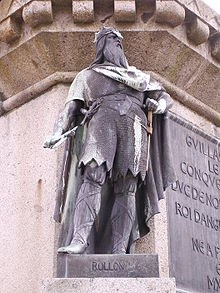
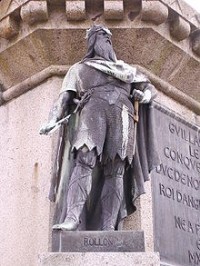
Statue of Rollo Rognvaldsson [in Ancient People & Artifacts]
Biography
| Birth | 14 October 846 | Rollo Hrólfr RögnvaldsSon, I; Don's 32nd GGF, was born on 14 October 846 in Scandinavia, EuropeG. The range of his DOB is from c. 835/870 He was also shown as born in Maer, Jutland in Nord-Trøndelag, Norway and in Denmark1,2 |
| Marriage | 891 | He and Poppa de Valois, of Rennes, were married in 891.1 |
| Death | 16 December 932 | He died on 16 December 932 at age 86 at RouenG, in Seine-Inférieure, Normandy, France (Medieval), EuropeG+. He died as the Duke of Normandy (at the age of 86) of unknown causes on Tuesday, December 16th, 932 is not known-surviving in 932 was difficult2 |
| Burial | after 932 | He was buried after 932 at Buried in the cemetery at the Cathédrale de Notre-DameG in Seine-Inférieure, Normandy, France (Medieval), EuropeG+. |
| Name | Rollo Hrólfr RögnvaldsSon, I; Don's 32nd GGF, was also known as Rollo the Viking. | |
| Name | He was also known as Rollo The Mighty. | |
| Name | He was also known as The Old Pirate. | |
| Name | He was also known as Rolf The Ganger. | |
| Name | He was also known as Robert. | |
| Name | He was also known as Göngu-Hrolf. | |
| Note | Parents were discovered as the tree was researched; they may be in question ------------------------------------------------------------------------------------ Rollo (Norman spelling: Rou and Rolloun; Old Norse: Hrólfr; French: Rollon) also known with his epithet, Rollo "the Walker," was a Viking who, as Count of Rouen, became the first ruler of Normandy, a region in today's northern France, Europe He was prominent among the Vikings who besieged Paris in 885–886, and he emerged as a war leader among the Norsemen who had secured a permanent foothold on Frankish soil in the valley of the lower Seine after the Siege of Chartres in 911. Charles the Simple, King of West Francia, agreed to the Treaty of Saint-Clair-sur-Epte, which granted Rollo lands between the river Epte and the sea in exchange for Rollo agreeing to end his brigandage, swear allegiance to Charles, convert to Christianity, and pledge to defend the Seine estuary from other Viking raiders Rollo's life was recorded by Dudo of St. Quentin. Historians such as W. Vogel, Alexander Bugge, and Henri Prentout have debated whether Dudo's account is historically accurate, and Rollo's origin and life are heavily disputed. Rollo is first recorded in a charter of 918 as the leader of a group of Viking settlers, and he reigned over the region of Normandy until at least 928. He was succeeded as ruler of the new Duchy of Normandy by his son William Longsword. The offspring of Rollo and his followers, through their intermingling with the local Frankish and Gallo-Roman population, became known as the "Normans." After the Norman conquest of England and of southern Italy and Sicily over the following two centuries, their descendants came to rule England, much of Ireland, Sicily and Antioch from the 11th to 13th centuries, leaving behind an enduring legacy in the histories of Europe and the Near East Name The Heimskringla (written in the 13th century) records that Rolf the Ganger went to Normandy and ruled it, so Rollo is generally presumed to be a Latinisation of the Old Norse name Hrólfr, a theory that is supported by the rendition of Hrólfr as Roluo in the Gesta Danorum by Saxo Grammaticus. It is also sometimes suggested that Rollo may be a Latinised version of another Norse name, Hrollaugr The 10th-century French historian Dudo in his Historia Normannorum records that Rollo took the baptismal name Robert. A variant spelling, Rou, is used in the 12th-century Norman French verse chronicle Roman de Rou, which was compiled by Wace and commissioned by King Henry II of England, a descendant of Rollo Origins and historiography Rollo was born in the mid-9th century, as his tomb states he was in his eighties when he died in 933; he was almost certainly born in Scandinavia, either in Denmark or Norway. In part, this uncertainty may result from the unspecific contemporary usage of terms such as "Vikings," "Northmen," "Norse," "Swedes," "Danes," and "Norwegians" (Dani vel Nortmanni in medieval Latin). The earliest well-attested historical event associated with Rollo is his part in leading the Vikings who besieged Paris in 885–886 but were fended off by Odo of France, Europe Sources do not make clear the year of Rollo's birth, but from his activity, marriage, children, and death, the mid-9th century may be inferred Among biographical remarks about Rollo written by the cleric Dudo of Saint-Quentin in the late 10th century, he claimed that Rollo "the Dane" was from Dacia, and had moved from there to the island of Scandza. Dacia originally referred to the region near the Black Sea, but Dudo identified it with Denmark by making a false etymology between Daci (Dacians) and Dani (Danes). One of Rollo's great-grandsons and a contemporary of Dudo was known as Robert the Dane. However, Dudo's Historia Normannorum (or Libri III de moribus et actis primorum Normanniae ducum) was commissioned by Rollo's grandson, Richard I of Normandy and while Dudo likely had access to family members and/or other people with a living memory of Rollo, this fact must be weighed against the text's potential biases, as an official biography According to Dudo, an unnamed King of Denmark was antagonistic to Rollo's family, including his father – an unnamed Danish nobleman – and Rollo's brother Gurim. Following the death of their father, Gurim was killed and Rollo was forced to leave Denmark. Dudo appears to have been the main source for William of Jumièges (after 1066) and Orderic Vitalis (early 12th century), although both include additional details A Norwegian background for Rollo was first explicitly claimed by Goffredo Malaterra (Geoffrey Malaterra), an 11th-century Benedictine monk and historian, who wrote: "Rollo sailed boldly from Norway with his fleet to the Christian coast." Likewise, the 12th-century English historian William of Malmesbury stated that Rollo was "born of noble lineage among the Norwegians" A chronicler named Benoît (probably Benoît de Sainte-More) wrote in the mid-12th-century Chronique des ducs de Normandie that Rollo had been born in a town named "Fasge." This has since been variously interpreted as referring to Faxe in Sjælland (Denmark), Fauske in Sykkylven (Norway), or perhaps a more obscure settlement that has since been abandoned or renamed. Benoît also repeated the claim that Rollo had been persecuted by a local ruler and had fled from there to "Scanza island," by which Benoît probably means Scania (Swedish Skåne). Benoît says elsewhere in the Chronique that Rollo is Danish Snorri Sturluson identified Rollo as Hrólfr the Walker (Norse Göngu-Hrólfr; Danish Ganger-Hrólf) from the 13th-century Icelandic sagas, Heimskringla and Orkneyinga Saga. Hrólf the Walker was so named because he "was so big that no horse could carry him." The Icelandic sources claim that Hrólfr was from Møre in western Norway, in the late 9th century and that his parents were the Norwegian jarl Rognvald Eysteinsson ('Rognvald the Wise') and a noblewoman from Møre named Hildr Hrólfsdóttir. However, these claims were made three centuries after the history commissioned by Rollo's own grandson There may be circumstantial evidence for kinship between Rollo and his historical contemporary Ketill Flatnose, King of the Isles – a Norse realm centered on the Western Isles of Scotland. Both Irish and Icelandic sources suggest that Rollo, as a young man, visited or lived in northern Scotland, where he had a daughter named Cadlinar (Kaðlín Kathleen). Icelandic sources name Ketill Flatnose's father as Björn Grímsson, which would imply that the name of Ketill Flatnose's paternal grandfather was Grim. That would be limited, onomastic evidence for a connection to Rollo, whose father (according to Richer) was named Ketill, while Rollo also (according to Dudo) had a brother named Gurim – a name likely cognate with Grim. In addition, Icelandic sources report that Rollo's ancestral home was Møre, where Ketill Flatnose's ancestors were also said to have originated. However, there are no surviving sources explicitly claiming a connection; Ketill was a common name in Norse societies, as were names like Gurim/Grim Biography Dudo's chronicle about Rollo seizing Rouen in 876 is supported by the contemporary chronicler Flodoard, who records that Robert of the Breton March waged a campaign against the Vikings, nearly leveling Rouen and other settlements. Eventually, he conceded "certain coastal provinces" to them. Although, scholars have debated this and have said that Rollo did not even arrive in West Francia until after the year 876, making this timeline given in Dudo wrong According to Dudo, Rollo struck up a friendship in England with a King called "Alstem". This has puzzled many historians, but recently this person has been identified as Guthrum, the Danish leader whom Alfred the Great baptized with the name "Athelstan", and was recognized as King of the East Angles in 880 Dudo recorded that when Rollo controlled Bayeux by force, he carried off the beautiful Popa or Poppa, a daughter of Berenger, Count of Rennes. He married her, and she bore his son and heir, William Longsword. Her parentage is uncertain, and may have been invented after the fact to legitimize her son's lineage, as many of the fantastic genealogical claims made by Dudo were. She may have come from any country with which the Norse had contact, as Dudo is a highly unreliable source who may have written his chronicle primarily as a didactic tool to teach courtly values Rollo's grave at the Cathedral of Rouen There are few contemporary mentions of Rollo. In 911, Robert I of France, brother of Odo, again defeated another band of Viking warriors in Chartres with his well-trained horsemen. This victory paved the way for Rollo's baptism and settlement in Normandy. In return for formal recognition of the lands he possessed, Rollo agreed to be baptized and assisted the king in defending the realm. As was custom, Rollo took the baptismal name "Robert", after his godfather, Robert I The seal of the agreement was to be a marriage between Rollo and Gisela, daughter of Charles, possibly her legitimate father. Since Charles first married in 907, that would mean that Gisela was at most 5 years old at the time of the treaty of 911 which offered her in marriage. It has therefore been speculated that she could have been an illegitimate daughter. However, a diplomatic child betrothal need not be doubted The earliest record of Rollo is from 918, in a charter of Charles III to an abbey, which referred to an earlier grant to "the Normans of the Seine," namely "Rollo and his associates" for "the protection of the kingdom." Dudo retrospectively stated that this pact took place in 911 at Saint-Clair-sur-Epte Dudo narrates a humorous story not found in other primary sources about Rollo's pledge of fealty to Charles III as part of the Treaty of Saint-Clair-sur-Epte. The attendant bishops urged Rollo to kiss the king's foot to prove his allegiance. Rollo refused, saying "I will never bow my knees at the knees of any man, and no man's foot will I kiss." Instead, Rollo commanded one of his warriors to kiss the king's foot. The warrior complied by raising the king's foot to his mouth as the king was standing, which "caused the king to topple backward" much to the amusement of their entourage. On taking his oath of fealty, Rollo divided the lands between the rivers Epte and Risle among his chieftains and settled in the de facto capital of Rouen Given Rouen and its hinterland in return for the alliance with the Franks, it was agreed upon that it was in the interests of both Rollo himself and his Frankish allies to extend his authority over Viking settlers. This would appear to be the motive for later concessions to the Vikings of the Seine, which are mentioned in other records of the time. When Charles III was being deposed by Rudolph of France he appealed to Rollo and Ragenold, another one of his Norman allies. With their combined army they marched to his aid in fulfillment of their pledge to the Carolingians, but were stopped at the Oise River by Charles' opponents who traded their cooperation for more territorial concessions. The need for an agreement was particularly urgent when Robert I, successor of Charles III, was killed in 923 Rudolph was recorded as sponsoring a new agreement by which a group of Norsemen conceded the provinces of the Bessin and Maine. These settlers were presumed to be Rollo and his associates, moving their authority westward from the Seine valley. It is still unclear as to whether Rollo was being given lordship over the Vikings already settled in the region to domesticate and restrain them, or the Franks around Bayeux to protect them from other Viking leaders settled in eastern Brittany and the Cotentin peninsula Rollo died sometime between a final mention of him by Flodoard in 928, and 933 – the year in which a third grant of land, usually identified as being the Cotentin and Avranchin areas, was given to his son and successor William Rollo's Role in Norman Conversion to Christianity In Dudo's story of Rollo, he had a vision in which he was on a high mountain on a Frankish dwelling, where he washed himself in a stream and rid himself of the diseases with which he was infected. He then saw birds of all kinds gather around the mountain and wash themselves in this stream, which remained together as a whole group and found twigs to build nests. This dream was interpreted to mean that the mountain was the church of Christianity, the diseases of which he rid himself were his sins being washed away and his being born again in the baptism of Christianity. The birds of different types represented the different armies and common people having their sins washed away and communities joined. The nests were the walls of the city to be rebuilt, and all were to bow down to Rollo to serve him. Rollo carried this vision with him throughout his journey to Normandy. Once he arrived and was granted land, he dedicated different sections of land to God, saints, and various churches. He was baptized and spread the word of Christianity to his followers This account of Rollo's role in Christianity has been long debated by scholars. In his 1752 work Micromégas, Voltaire wrote that "peaceful Rollo was the only legislator of his time on the Christian continent." Recently, Scholars have said that Rollo's law-making was the cause of the civilization of Normandy, not his actual conversion to Christianity. While it has been supported that Rollo and his companions did get baptized, it has been argued that this conversion was only formal at first and paganism was still practiced Descendants Rollo's son and heir, William Longsword, and grandchild, Richard the Fearless, forged the Duchy of Normandy into West Francia's most cohesive and formidable principality. The descendants of Rollo and his men assimilated with the Frankish culture and became known as the Normans, lending their name to the region of Normandy Rollo was the great-great-great-grandfather of William the Conqueror, the progenitor of House of Normandy in England. As such, Charles III and the current British royal family are descendants of Rollo, albeit not in the direct male line. Henry I of England was the last monarch of the House of Normandy; but his daughter Empress Matilda was ancestral to the English House of Plantagenêt and subsequent English monarchs A genetic investigation into the remains of Rollo's grandson Richard the Fearless, and his great-grandson Richard the Good, was announced in 2011 to discern the origins of the historic Viking leader. On 29 February 2016, Norwegian researchers opened Richard the Good's tomb and found a lower jaw with eight teeth in it. However, the skeletal remains in both graves turned out to significantly predate Rollo and therefore are not related to him Legacy Rollo's dynasty survived through a combination of ruthless military action and infighting among the 10th-century Frankish aristocracy, which left them severely weakened and unable to resist the Rouen Vikings' growing determination to stay put. After Rollo's death, his direct male descendants continued to rule Normandy until Stephen of Blois became King of England and Duke of Normandy in 1135. The duchy was later absorbed into what became the Angevin Empire following its conquest by Geoffrey of Anjou, who in 1128 had married Matilda of England, herself a descendant of Rollo Rollo left a legacy as the founder of Normandy, and his leadership and integration of Viking settlers into the region transformed it into a stable political entity. His lineage played a key role in shaping medieval Europe, as it was William the Conqueror, another descendant of Rollo, who famously led the Norman Conquest of England in 1066. Rollo's baptism also marked a significant point in the assimilation of Viking settlers into Frankish society. | |
| Web Address | He shares a website (or access to one) that has source data here: https://en.wikipedia.org/wiki/Rollo | |
| Title | after 885 | He held the title of Duke of Normandy after 885. |
| Adult Christening | 912 | He was christened as an adult in 912 at RouenG, in Seine-Inférieure, Normandy, France (Medieval), EuropeG+.3 |
| Religious Affiliation | before 932 | He was affiliated with Norse Paganism, later as the Roman Catholicism before 932. |
| Last Edited | 26 September 2026 |
Citations
- [S832] Heritage Consulting, Millennium File (Provo, Utah, USA: Ancestry.com Operations Inc, 2003).

- [S385] "Find A Grave Index," database, FamilySearch (https://familysearch.org/pal:/MM9.1.1/QVV9-1HZZ: 13 December 2015), Rollo Rognvaldsson,; Burial, Rouen, Departement de la Seine-Maritime, Haute-Normandy, France, Cathédrale Notre-Dame de Rouen; citing record ID 8195891, Find a Grave, http://www.findagrave.com
- [S469] Wiki
Poppa de Valois, of Rennes
F, #1933, Deceased, b. 872, d. 11 August 938
| References | Don's Family and His Direct Ancestors The Most Ancient of Don's Actual Ancients, Enos ben Seth |
| Pedigree Link |
Family
Family: Rollo Hrólfr RögnvaldsSon, I; Don's 32nd GGF (b. 14 October 846, d. 16 December 932)
| Son* | Guillaume RollosSon, I (of Normandy); Don's 31st GGF+ (b. 28 August 893, d. 17 December 942) |
| Daughter* | Adèle RollosDóttir, of Normandy+ (b. 912, d. 14 October 962) |
Person Exhibits
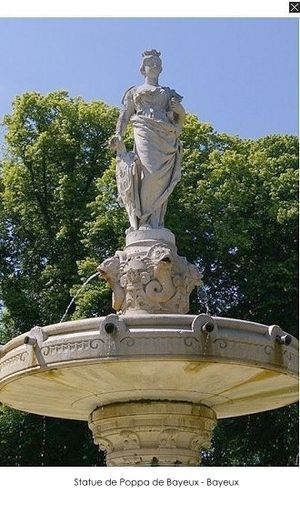
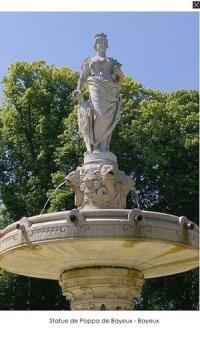
Bayeux Statue of Poppa [in the Gravestone collection]
Biography
| Birth | 872 | Poppa de Valois, of Rennes, was born in 872 at ÉvreuxG, in Eure, Haute-Normandy, France (Medieval), EuropeG. |
| Marriage | 891 | Rollo Hrólfr RögnvaldsSon, I; Don's 32nd GGF, and she were married in 891.1 |
| Death | 11 August 938 | She died on 11 August 938 at age ~66 at RouenG, in Seine-Inférieure, Normandy, France (Medieval), EuropeG+. The cause of her death (at the age of 66) on Monday, August 11th, 938 is not known-surviving in 938 was difficult Died as the Duchess of Normandy |
| Burial | after 11 August 938 | She was buried after 11 August 938 at Buried in an unknown cemetery in RouenG, in Seine-Inférieure, Normandy, France (Medieval), EuropeG+. |
| Name | Poppa de Valois, of Rennes, was also known as Gisela de Senlis de Valois, of Rennes.1 | |
| Web Address | She shares a website (or access to one) that has source data here: https://en.wikipedia.org/wiki/Poppa_of_Bayeux | |
| Person Source | She had person sources.2 | |
| Title | after 872 | She held the title of Duchess of Normandy after 872 in France (Medieval), EuropeG+. |
| Last Edited | 19 November 2025 |
Citations
- [S832] Heritage Consulting, Millennium File (Provo, Utah, USA: Ancestry.com Operations Inc, 2003).
- [S1] , DJS: Source for an unsourced person (N.p.: n.p., n.d.)., --Citation added for an unsourced person-- Every element of Don's family tree is legally controlled: "All Rights Reserved © (Apr-1988 to today) by Don Shave"
Philip de Courtenay
M, #1934, Deceased, b. 1277, d. 24 June 1314
| References | Don's Family and His Direct Ancestors |
Parents
| Father* | Hugh de Courtenay, Sr. (b. 25 March 1249, d. 28 February 1292) |
| Mother* | Eleanor le Despencer (b. 1246, d. 30 September 1328) |
| Pedigree Link |
Biography
| Birth | 1277 | Philip de Courtenay was born in 1277 in Okehampton, Devonshire, England (Medieval), EuropeG. |
| Death | 24 June 1314 | He died on 24 June 1314 at age ~37 in Stirling, Stirlingshire, Scotland (Medieval), EuropeG. Philip (Sir; Knight; Lord of Manedon), the 2nd son of Hugh and was slain in Medieval Scotland (at the age of 37) on Sunday, June 24th, 1314 at Stirling (Shivelin) |
| Burial | after 24 June 1314 | He was buried after 24 June 1314 at Buried in an unknown cemeteryG in England (Medieval), EuropeG+. |
| Person Source | Philip de Courtenay had person sources.1 | |
| Title | before 1314 | He held the title of Knight; Lord of Manedon; Sir before 1314. |
| Last Edited | 23 April 2024 |
Citations
- [S1] , DJS: Source for an unsourced person (N.p.: n.p., n.d.)., --Citation added for an unsourced person-- Every element of Don's family tree is legally controlled: "All Rights Reserved © (Apr-1988 to today) by Don Shave"
Philip Pointon
M, #1935, Deceased, b. 1786, d. after October 1786
Parents
| Father* | Thomas Pointon (b. 1753, d. 1813) |
| Mother* | Martha Harrison (b. 1752, d. about 1815) |
| Pedigree Link |
Biography
| Birth | 1786 | Philip Pointon was born in 1786 in Burslem, Staffordshire, England (Kingdom of Great Britain), EuropeG. |
| Death | after October 1786 | He died after October 1786 in Burslem, Staffordshire, England (Kingdom of Great Britain), EuropeG. The cause of his death (sadly, as an infant in his 1st year) in October, 1786 is not known-surviving in 1786 as an infant was difficult & it occurred in the Kingdom of Great Britain |
| Baptism | 29 October 1786 | Philip Pointon was baptized on 29 October 1786 in Burslem, Staffordshire, England (Kingdom of Great Britain), EuropeG.1 |
| Last Edited | 8 July 2023 |
Citations
- [S1787] Ancestry.com, England, Select Births and Christenings, 1538-1975 (Provo, UT, USA: Ancestry.com Operations, Inc, 2014).
Thomas Pointon
M, #1936, Deceased, b. 1795, d. after 1795
Parents
| Father* | Thomas Pointon (b. 1753, d. 1813) |
| Mother* | Martha Harrison (b. 1752, d. about 1815) |
| Pedigree Link |
Biography
| Birth | 1795 | Thomas Pointon was born in 1795 in Burslem, Staffordshire, England (Kingdom of Great Britain), EuropeG. |
| Death | after 1795 | He died after 1795 in Burslem, Staffordshire, England (Kingdom of Great Britain), EuropeG. The cause of his death (sadly, as an infant in his 1st year) in the year of 1795 is not known-surviving in 1795 as an infant was difficult & it occurred in the Kingdom of Great Britain |
| Person Source | Thomas Pointon had person sources.1 |
| Last Edited | 9 April 2024 |
Citations
- [S1] , DJS: Source for an unsourced person (N.p.: n.p., n.d.)., --Citation added for an unsourced person-- Every element of Don's family tree is legally controlled: "All Rights Reserved © (Apr-1988 to today) by Don Shave"
Thomas Pointon
M, #1937, Deceased, b. 1753, d. 1813
| References | Don's Family and His Direct Ancestors |
Parents
| Father* | Phillip Poynton (b. about 1733, d. after 1753) |
| Mother* | Anne (b. about 1733, d. after 1753) |
| Pedigree Link |
Family
Family: Martha Harrison (b. 1752, d. about 1815)
| Daughter* | Ann Pointon (b. 1776, d. 1819) |
| Son* | Benjamin Pointon (b. 1778, d. after April 1778) |
| Daughter* | Martha Pointon (b. 14 March 1784, d. June 1852) |
| Son* | Philip Pointon (b. 1786, d. after October 1786) |
| Daughter* | Ellen Pointon (b. 1793, d. after 1793) |
| Son* | Thomas Pointon (b. 1795, d. after 1795) |
| Son* | William Pointon (b. 1802, d. after 1802) |
Biography
| Birth | 1753 | Thomas Pointon was born in 1753 in County of Staffordshire, England (Kingdom of Great Britain), EuropeG. |
| Marriage | 19 April 1773 | He and Martha Harrison were married on 19 April 1773 in Wilmslow, Cheshire, England (Kingdom of Great Britain), EuropeG. Sources (unk 1) has date of 17 Apr 1775 & location "1652401 Staffordshire" (unk 2) had incorrect year of 1815 / death & location "Warrington, Lancashire"1 |
| Death | 1813 | He died The cause of his death (at the age of 60) in the year of 1813 is not known in 1813 at age ~60 in County of Staffordshire, England (United Kingdom), EuropeG. His death occurred in today's England |
| Baptism | 6 May 1753 | Thomas Pointon was baptized on 6 May 1753 in Norton in the Moors, Stafford County, England (Kingdom of Great Britain), EuropeG.2 |
| Last Edited | 23 November 2022 |
Citations
Samuel Walbridge
M, #1938, Deceased, b. before 14 February 1847, d. after 1861
Parents
| Father* | Samuel Walbridge (b. 30 March 1811, d. 17 July 1892) |
| Mother* | Mary Ann Groves (b. about 1811, d. July 1890) |
| Pedigree Link |
Biography
| Birth | before 14 February 1847 | Samuel Walbridge was born before 14 February 1847 in Powerstock, County of Dorset, England (United Kingdom), EuropeG+.1 |
| Death | after 1861 | He died The cause of his death (as a teenager aged 14) in the year of 1861 is not known after 1861 in Powerstock, County of Dorset, England (United Kingdom), EuropeG+. His death occurred in today's England (location not known; used birth place) |
| Person Source | Samuel Walbridge had person sources.2,3 | |
| Baptism | 14 February 1847 | He was baptized on 14 February 1847 in Powerstock, County of Dorset, England (United Kingdom), EuropeG+. |
| Residence | 1851 | He lived in Powerstock, County of Dorset, England (United Kingdom), EuropeG+, in 1851. Resource event had no description; added / NFIA4 |
| Residence | 1861 | He lived in Powerstock, County of Dorset, England (United Kingdom), EuropeG+, in 1861. Resource event had no description; added / NFIA |
| Last Edited | 25 April 2023 |
Citations
- [S1361] Ancestry.com, 1861 England Census (Provo, UT, USA: Ancestry.com Operations Inc, 2005)., Source Citation: Class: RG 9; Piece: 1365; Folio: 102; Page: 9; GSU roll: 542802
- [S2116] RG9/1365 F98, F99 & F101
Part of the parish of Powerstock comprising the village of Powerstock, the tithing of South Poorton, including Witherstone and Loscombe, Parish of Powerstock, Ecclesiastical District of Powerstock[and…] - [S2040] Transcribed from the Bishops Transcripts at Poorstock (Powerstock) bySandy Pearcey, Powerstock Parish BAPTISMS (Name: Baptism web page: http://www.dorset-opc.com/PowerstockBaps1.htm; Related web page: http://www.dorset-opc.com/Powerstock.htm), See filtered list(s)
- [S1051] Ancestry.com, 1851 England Census (Provo, UT, USA: Ancestry.com Operations Inc, 2005)., Class: HO107; Piece: 1860; Folio: 501; Page: 16; GSU roll: 221008
John de Courtenay
M, #1939, Deceased, b. 26 July 1224, d. 3 May 1274
| References | Don's Family and His Direct Ancestors |
Parents
| Father* | John de Courtenay (b. about 1200, d. after 1224) |
| Mother* | Mary de Reviers (b. about 1200, d. after 1224) |
| Pedigree Link |
Family
Family: Isabel de Vere (b. about 1228, d. 11 August 1300)
| Son* | Hugh de Courtenay, Sr.+ (b. 25 March 1249, d. 28 February 1292) |
Person Exhibits
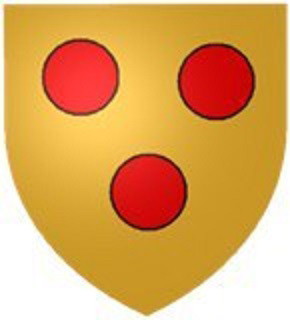
Courtenay [in Coats of Arms & Flags]
Biography
| Birth | 26 July 1224 | John de Courtenay was born on 26 July 1224 in Okehampton, Devonshire, England (Medieval), EuropeG.1,2 |
| Death | 3 May 1274 | He died on 3 May 1274 at age 49 in Okehampton, Devonshire, England (Medieval), EuropeG. The cause of his death (at the age of 50) on Thursday, May 3rd, 1274 is not known-surviving in 1274 was difficult Died as the Baron of Okehampton |
| Burial | after 3 May 1274 | He was buried after 3 May 1274 at Buried in an unknown cemeteryG in Thorncombe, Dorsetshire, England (Medieval), EuropeG. |
| Person Source | John de Courtenay had person sources.3 | |
| Title | before 1274 | He held the title of Baron of Okehampton before 1274. |
| Last Edited | 25 April 2023 |
Citations
- [S228] Ancestry.com Operations, Inc
Location: Provo, UT, USA
Date: 2012 - [S832] Heritage Consulting, Millennium File (Provo, Utah, USA: Ancestry.com Operations Inc, 2003).
- [S853] Godfrey Memorial Library comp, American Genealogical-Biographical Index (AGBI) (Provo, UT, USA: Ancestry.com Operations, Inc, 1999).
Elen Lwyddog verch Eudaf Hên, {Romans}
F, #1940, Deceased, b. 340, d. 390
Parents
| Father* | Eudaf Hên ap Einudd, of Britain {Romans} (b. 283, d. 340) |
| Mother* | Fausta Carausius, {Romans} (b. 295, d. 350) |
| Pedigree Link |
Families
Family 1: Magnus Maximus Clemens Macsen ap Wledig, of the Western Roman Empire {Romans} (b. 7 August 340, d. 28 August 388)
| Son* | Eochaid Allmuir, {Romans} (b. about 353, d. about 400) |
| Daughter* | Gratian verch Macsen Wledig, {Romans}+ (b. 360, d. about 415) |
| Son* | Aldroenus Maximus, {Romans} (b. 363, d. 410) |
| Daughter* | Magna, of Roman Gaul {Romans} (b. 367, d. 420) |
| Son* | Ednyfed ap Annun, {Romans} (b. about 370, d. after 370) |
| Daughter* | Sevra verch Macsen Wledig, {Romans} (b. about 370, d. about 422) |
Family 2: Flavius Julius Constantinus, of Rome {Romans} (b. 7 August 317, d. 5 October 361)
| Son* | Gwidyr ap MacSen, {Romans} (b. about 353, d. after 353) |
| Son* | Publicas ap MacSen, {Romans} (b. about 354, d. after 354) |
| Daughter* | Severa verch MacSen, {Romans} (b. about 355, d. after 355) |
| Son* | Anwn Dynod ap MacSen, {Romans} (b. about 356, d. after 376) |
| Son* | Owain Finddu ap MacSen, {Romans} (b. about 357, d. after 357) |
| Daughter* | Gratiana ferch MacSen, {Romans} (b. about 358, d. after 358) |
| Son* | Constantine ap MacSen, {Romans} (b. 361, d. September 411) |
Person Exhibits

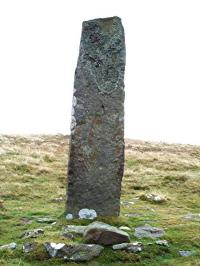
Gravestone of Elen [in the Gravestone collection]

Image of Elen Lwyddog verch Eudaf Hen [in People]
Biography
| Birth | 340 | Elen Lwyddog verch Eudaf Hên, {Romans}, was born in 340 at Caïr-Segeint (Caïrnarfon)G in Monmouth, Monmouthshire, Roman Wales, EuropeG. Source (lost) shares date as 325 (would make her too old) and location as "Ewyas Monmouth, Glamorgan, Wales" |
| Marriage | 353 | Magnus Maximus Clemens Macsen ap Wledig, of the Western Roman Empire {Romans}, and she were married in 353 in Roman Wales, EuropeG+. |
| Marriage | before October 361 | Flavius Julius Constantinus, of Rome {Romans}, and she were married before October 361 in Roman Wales, EuropeG+. |
| Death | 390 | She died in 390 at age ~50 at Hadrian's WallG in Roman Scotland, EuropeG+. The cause of her death (at the age of 50) in the year of 390 is not known-surviving in 390 was difficult & it occurred in Roman Scotland; Source (lost) shares year as 403 and places as Caernarfon, Caernarvonshire, Wales and Yhys, Wales/Forgotten Monarchy |
| Name | Elen Lwyddog verch Eudaf Hên, {Romans}, was also known as Eudaf Helen Helena Luyddog, {Romans}. | |
| Note | [ from an HTML file ] She was born circa 340 as the daughter of Father is King of Ewyas Eudaf Hen ab Einydd of Britain St. Elen Lwyddog verch Eudaf of Britain also went by the name of St. Elen "of the Host". Her epithet "Lwyddog" means "of the Host" She married Western Emperor Magnus Clemens Maximus Constantine, son of imperator Constans I Flavius Julius Constans, before 355; his 2nd wife, b. circa 340, d. 388 Their Children Anwn Dynod ap Macsen+ b. c 3551 Constantine ap Macsen b. c 3581 Severa verch Macsen+ b. c 3701 Gratianna verch Macsen+ b. c 3701 Citations [S266] EBK, online http://freespace.virgin.net/david.ford2/… [S640] History Files, online http://homepages.tesco.net/~plk33/plk33/history.htm. | |
| Person Source | She had person sources.1 | |
| Title | after 340 | She held the title of Hên of Britain; Helena; Saint of the Host after 340 in Roman England, EuropeG+. |
| Religious Affiliation | before 390 | She was affiliated with Lwyddog verch St. Elen before 390. |
| Last Edited | 6 March 2026 |
Citations
- [S1] , DJS: Source for an unsourced person (N.p.: n.p., n.d.)., --Citation added for an unsourced person-- Every element of Don's family tree is legally controlled: "All Rights Reserved © (Apr-1988 to today) by Don Shave"
Lois M. Ehlinger, {assess} DOB is close enough
F, #1941, Deceased, b. 13 October 1922, d. 29 May 1977
Parents
| Father* | Lawrence N. Ehlinger (b. 6 January 1906, d. 12 December 1993) |
| Mother* | Cleo Marie SørenSen (b. 9 April 1910, d. 7 February 2000) |
| Pedigree Link |
Biography
| Birth | 13 October 1922 | Lois M. Ehlinger, {assess} DOB is close enough, was born on 13 October 1922 in Lake Geneva, Walworth County, Wisconsin, United States (North America)G.1,2 |
| Marriage | 13 January 1951 | Eugene Byron Detert and she were married on 13 January 1951 in Suring, Oconto County, Wisconsin, United States (North America)G. |
| Death | 29 May 1977 | She died The cause of her death (at the age of 55) on Sunday, May 29th, 1977 is not known on 29 May 1977 at age 54 in Oconto Falls, Oconto County, Wisconsin, United States (North America)G. Her death occurred in the State of Wisconsin |
| Residence | 1935 | Lois M. Ehlinger, {assess} DOB is close enough, lived in Suring, Oconto County, Wisconsin, United States (North America)G, in 1935. Resource event had no description; added / NFIA |
| Residence | 1 April 1940 | She lived in Suring, Oconto County, Wisconsin, United States (North America)G, on 1 April 1940. Marital Status: Single; Relation to Head of House: Daughter |
| Last Edited | 25 April 2023 |
Citations
- [S1021] Ancestry.com, 1940 United States Federal Census (Provo, UT, USA: Ancestry.com Operations, Inc, 2012)., Year: 1940; Census Place: Suring, Oconto, Wisconsin; Roll: T627_4506; Page: 1B; Enumeration District: 42-35
- [S1562] Ancestry.com, Wisconsin, Death Index, 1959-1997 (Provo, UT, USA: Ancestry.com Operations Inc, 2007).
Lawrence N. Ehlinger
M, #1942, Deceased, b. 6 January 1906, d. 12 December 1993
| Pedigree Link |
Family
Family: Cleo Marie SørenSen (b. 9 April 1910, d. 7 February 2000)
| Daughter* | Lois M. Ehlinger, {assess} DOB is close enough (b. 13 October 1922, d. 29 May 1977) |
| Son* | Dane L. Ehlinger (b. about 1929) |
| Son* | Donald D. Ehlinger (b. 13 January 1929, d. 12 March 2011) |
Biography
| Birth | 6 January 1906 | Lawrence N. Ehlinger was born on 6 January 1906 in How, Oconto County, Wisconsin, United States (North America)G.1 |
| Marriage | 19 June 1928 | He and Cleo Marie SørenSen were married on 19 June 1928 in Antigo, Langlade County, Wisconsin, United States (North America)G. |
| Death | 12 December 1993 | He died The cause of his death (at the age of 87) on Sunday, December 12th, 1993 is not known on 12 December 1993 at age 87 in How, Oconto County, Wisconsin, United States (North America)G. His death occurred in the State of Wisconsin (location not known; used birth place) |
| Name | Lawrence N. Ehlinger was also known as Laurice Ehlinger.2 | |
| Residence | 1930 | He lived in Mineral Hills, Iron County, Michigan, United States (North America)G, in 1930. Marital Status: Married; Relation to Head of House: Head |
| Residence | 1935 | He lived in Suring, Oconto County, Wisconsin, United States (North America)G, in 1935. Resource event had no description; added / NFIA |
| Residence | 1 April 1940 | He lived in Suring, Oconto County, Wisconsin, United States (North America)G, on 1 April 1940. Marital Status: Married; Relation to Head of House: Head |
| Residence | 1943 | He lived in County of Kenosha, Wisconsin, United States (North America)G, in 1943. Resource event had no description; added / NFIA3 |
| Last Edited | 25 April 2023 |
Citations
- [S1797] Ancestry.com, 1930 United States Federal Census (Provo, UT, USA: Ancestry.com Operations Inc, 2002)., Year: 1930; Census Place: Mineral Hills, Iron, Michigan; Roll: 994; Page: 4B; Enumeration District: 0010; Image: 808.0; FHL microfilm: 2340729
- [S1021] Ancestry.com, 1940 United States Federal Census (Provo, UT, USA: Ancestry.com Operations, Inc, 2012)., Year: 1940; Census Place: Suring, Oconto, Wisconsin; Roll: T627_4506; Page: 1B; Enumeration District: 42-35
- [S1055] Ancestry.com, U.S. City Directories, 1822-1995 (Provo, UT, USA: Ancestry.com Operations, Inc, 2011).
Tracy Marcks
F, #1943, Living, b. about 1971
| Pedigree Link |
Biography
| Birth | about 1971 | Tracy Marcks was born about 1971. |
| Marriage | 28 July 2007 | Michael Paul Musil and she were married on 28 July 2007. |
| Person Source | Tracy Marcks had person sources.1 |
| Last Edited | 9 April 2024 |
Citations
- [S1] , DJS: Source for an unsourced person (N.p.: n.p., n.d.)., --Citation added for an unsourced person-- Every element of Don's family tree is legally controlled: "All Rights Reserved © (Apr-1988 to today) by Don Shave"
Alfred Dodson
M, #1944, Deceased, b. about 1856, d. after 1871
| References | Don's Family and His Direct Ancestors |
Parents
| Father* | Joseph Dodson, Don's 2nd Maternal GGF (b. 3 February 1824, d. April 1874) |
| Mother* | Kezia Hoard, Don's 2nd Maternal GGM (b. 6 December 1825, d. January 1896) |
| Pedigree Link |
Biography
| Birth | about 1856 | Alfred Dodson was born about 1856 in District of Newington, Region of Greater London, England (United Kingdom), EuropeG+.1,2 |
| Death | after 1871 | He died The cause of his death (as a teenager aged 15) in the year of 1871 is not known after 1871 in District of Newington, Region of Greater London, England (United Kingdom), EuropeG+. His death occurred in today's England (location not known; used birth place) |
| Residence | 1861 | Alfred Dodson lived in District of Newington, Region of Greater London, England (United Kingdom), EuropeG+, in 1861. Church of St. Mary |
| Residence | 1871 | He lived at St Mary Newington Church (near both Newington and Walworth)G+ in District of Newington, Region of Greater London, England (United Kingdom), EuropeG+, in 1871. Age: 15; Relation to Head of House: Son |
| Last Edited | 15 May 2023 |
Citations
- [S422] Ancestry.com, 1871 England Census (Provo, UT, USA: Ancestry.com Operations Inc, 2004)., Source Citation: Class: RG10; Piece: 613; Folio: 42; Page: 1; GSU roll: 818914
- [S1361] Ancestry.com, 1861 England Census (Provo, UT, USA: Ancestry.com Operations Inc, 2005)., Class: RG 9; Piece: 345; Folio: 162; Page: 10; GSU roll: 542619
Elizabeth Payne
F, #1945, Deceased, b. about 1584, d. 14 September 1670
Parents
| Father* | William Payne (b. about 1564, d. after 1584) |
| Mother* | (Mother), of Elizabeth-by William (b. about 1564, d. after 1584) |
| Pedigree Link |
Family
Family: William Hammond (b. 1575, d. 8 October 1662)
| Daughter* | Ann Hammond+ (b. 19 November 1609, d. 1 September 1685) |
Biography
| Birth | about 1584 | Elizabeth Payne was born about 1584 in England (Tudor), EuropeG+.1,2,3 |
| Marriage | 9 June 1605 | William Hammond and she were married on 9 June 1605 in England (Tudor), EuropeG+.4,5,2 |
| Death | 14 September 1670 | She died on 14 September 1670 at age ~86 in Watertown, Suffolk County, England (Tudor), EuropeG. The cause of her death (at the age of 86) on Sunday, September 14th, 1670 is not known-surviving in 1670 was difficult & it occurred in Tudor England4 |
| Baptism | 11 September 1586 | Elizabeth Payne was baptized on 11 September 1586 in Lavenham, Suffolk County, England (Tudor), EuropeG.5 |
| Arrival | 1637 | She arrived in the US at in Salem Village, Colonial County of Essex, The Colony of Massachusetts Bay, British Colonial America (North America)G+, on or around in 1637 an actual Immigration event may not be present |
| Last Edited | 25 April 2023 |
Citations
- [S375] Ancestry.com, U.S. & Canada, Passenger and Immigration Lists Index, 1500s-1900s (Provo, UT, USA: Ancestry.com Operations, Inc, 2010)., Place: Salem, Massachusetts; Year: 1637; Page Number: 340
- [S1913] Yates Publishing, U.S. and International Marriage Records, 1560-1900 (Provo, UT, USA: Ancestry.com Operations Inc, 2004)., Source number: 690.000; Source type: Electronic Database; Number of Pages: 1; Submitter Code: LMM
- [S833] Ancestry.com, Massachusetts, Town and Vital Records, 1620-1988 (Provo, UT, USA: Ancestry.com Operations, Inc, 2011).
- [S1112] Genealogical Publishing Co; Baltimore, MD, USA; Volume Title: New England Marriages Prior to 1700
- [S832] Heritage Consulting, Millennium File (Provo, Utah, USA: Ancestry.com Operations Inc, 2003).
Thomas Stevens, 1St
M, #1946, Deceased, b. 9 February 1701, d. 27 February 1701
| References | Don's Family and His Direct Ancestors |
Parents
| Father* | Henry Stevens (b. 1646, d. about October 1736) |
| Mother* | Ruth Hunt (b. 1654, d. September 1723) |
| Pedigree Link |
Biography
| Birth | 9 February 1701 | Thomas Stevens, 1St, was born on 9 February 1701 in Winterbourne Saint Martin, Dorsetshire, England (Tudor), EuropeG. |
| Death | 27 February 1701 | He died on 27 February 1701 at age 0 in Winterbourne Saint Martin, Dorsetshire, England (Tudor), EuropeG. The cause of his death (sadly, as an infant of 18 days) on Sunday, February 27th, 1701 is not known-surviving in 1701 as an infant was difficult & it occurred in Tudor England |
| Person Source | Thomas Stevens, 1St, had person sources.1 | |
| Christening | 20 February 1701 | He was christened on 20 February 1701 in Winterbourne Saint Martin, Dorsetshire, England (Tudor), EuropeG. |
| Last Edited | 17 January 2025 |
Citations
- [S1] , DJS: Source for an unsourced person (N.p.: n.p., n.d.)., --Citation added for an unsourced person-- Every element of Don's family tree is legally controlled: "All Rights Reserved © (Apr-1988 to today) by Don Shave"
Ruth Stevens
F, #1947, Deceased, b. 22 February 1722/23, d. after 1722
Parents
| Father* | Henry Stevens (b. 21 July 1695, d. January 1741) |
| Mother* | Alice Wyar (b. March 1687/88, d. February 1760) |
| Pedigree Link |
Biography
| Birth | 22 February 1722/23 | Ruth Stevens was born on 22 February 1722/23 in Winterbourne Saint Martin, Dorsetshire, England (Kingdom of Great Britain), EuropeG. |
| Death | after 1722 | She died after 1722 in Winterbourne Saint Martin, Dorsetshire, England (Kingdom of Great Britain), EuropeG. The cause of her death (sadly, as an infant in her 1st year) in the year of 1722 is not known-surviving in 1722 as an infant was difficult & it occurred in the Kingdom of Great Britain (location not known; used birth place) |
| Person Source | Ruth Stevens had person sources.1 |
| Last Edited | 9 April 2024 |
Citations
- [S1] , DJS: Source for an unsourced person (N.p.: n.p., n.d.)., --Citation added for an unsourced person-- Every element of Don's family tree is legally controlled: "All Rights Reserved © (Apr-1988 to today) by Don Shave"
Henry Taylor Richards
M, #1948, Deceased, b. 31 May 1843, d. 6 December 1926
Parents
| Father* | (Father) Richards, of 2 children-by Susannah (b. about 1825, d. after 1843) |
| Mother* | Susannah Waters, Research name (had a "?") (b. about 1808, d. 1872) |
| Pedigree Link |
Family
Family: Margaret Thornell (b. 17 July 1837, d. 13 February 1931)
| Daughter* | Ida L. Richards (b. 4 February 1867, d. 29 July 1947) |
| Son* | William Oceola Ocee Richards (b. May 1868, d. 26 December 1936) |
| Son* | John Henry Richards (b. 27 June 1869, d. 13 August 1870) |
| Daughter* | Susan Elizabeth Richards (b. 1872, d. 18 January 1872) |
| Son* | Robert Oscar Richards (b. 23 November 1872, d. 5 March 1917) |
| Daughter* | Lilla Jane Richards (b. 29 August 1874, d. after 1880) |
| Son* | James Marvin Richards (b. 12 July 1876, d. 1948) |
Person Exhibits

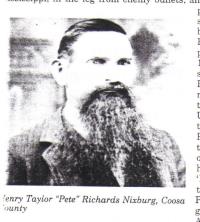
Henry Taylor Pete Richards [in People]
Biography
| Birth | 31 May 1843 | Henry Taylor Richards was born on 31 May 1843 in Nixburg, Coosa County, Alabama, United States (North America)G.1 |
| Marriage | 6 May 1866 | He and Margaret Thornell were married on 6 May 1866 in Nixburg, Coosa County, Alabama, United States (North America)G.2 |
| Death | 6 December 1926 | He died The cause of his death (at the age of 83) on Monday, December 6th, 1926 is not known on 6 December 1926 at age 83 at 803 Madison AveG in County of Montgomery, Alabama, United States (North America)G. His death occurred in the State of Alabama3,4 |
| Burial | after 6 December 1926 | He was buried after 6 December 1926 at Buried in an unknown cemeteryG in Nixburg, Coosa County, Alabama, United States (North America)G.5 |
| Name | Henry Taylor Richards was also known as Pete, Likely His Every-Day Name. | |
| Person Source | He had person sources.6,7 | |
| Residence | 1850 | He lived in County of Coosa, Alabama, United States (North America)G, in 1850. Resource event had no description; added / NFIA |
| Residence | 1870 | He lived in Nixburg, Coosa County, Alabama, United States (North America)G, in 1870. Resource event had no description; added / NFIA8 |
| Residence | 1880 | He lived in Nixburg, Coosa County, Alabama, United States (North America)G, in 1880. Resource event had no description; added / NFIA9 |
| Residence | 1900 | He lived in Nixburg, Coosa County, Alabama, United States (North America)G, in 1900. Resource event had no description; added / NFIA2 |
| Residence | 1910 | He lived in Nixburg, Coosa County, Alabama, United States (North America)G, in 1910. Resource event had no description; added / NFIA10 |
| Residence | 1921 | He lived in County of Coosa, Alabama, United States (North America)G, in 1921. Resource event had no description; added / NFIA |
| Residence | 7 January 1926 | He lived in County of Coosa, Alabama, United States (North America)G, on 7 January 1926. Can't be on 1927 |
| Last Edited | 14 May 2023 |
Citations
- [S1750] Ancestry.com, 1850 United States Federal Census (Provo, UT, USA: Ancestry.com Operations, Inc, 2009)., Year: 1850; Census Place: Coosa, Coosa, Alabama; Roll: M432_4; Page: 82A; Image: 172
- [S1795] Ancestry.com, 1900 United States Federal Census (Provo, UT, USA: Ancestry.com Operations Inc, 2004)., Source Citation: Year: 1900; Census Place: Nixburg, Coosa, Alabama; Roll: 12; Page: 5A; Enumeration District: 0019; FHL microfilm: 1240011
- [S1968] Tweaked by DJS, Ancestry.com, Alabama, Deaths and Burials Index, 1881-1974 (Name: Ancestry.com Operations, Inc; Location: Provo, UT, USA; Date: 2011) (N.p.: n.p., n.d.).
- [S190] Ancestry.com, Alabama Deaths, 1908-59 (Name: Ancestry.com Operations Inc; Location: Provo, UT, USA; Date: 2000)
- [S186] Ancestry.com, Web: Alabama, Find A Grave Index, 1755-2012 (Name: Ancestry.com Operations, Inc; Location: Provo, UT, USA; Date: 2012)
- [S205] Ancestry.com, Alabama, Census of Confederate Soldiers, 1907, 1921 (Name: Ancestry.com Operations, Inc; Location: Provo, UT, USA; Date: 2010), Alabama Department of Archives & History; Montgomery, Alabama; Alabama Census of Confederate Soldiers, 1907 and 1921; Roll: 46th Alabama Infantry Regiment; Roll Number: 52
- [S565] Ancestry.com, Alabama, Texas and Virginia, Confederate Pensions, 1884-1958 (Provo, UT, USA: Ancestry.com Operations, Inc, 2010)., Alabama Department of Archives and History; Montgomery, Alabama; Confederate Pension Applications, 1880-1940; Collection #: Microfilm in the Research Room; Roll Description: Rice, L. M. - Riddle, Hirum W
- [S1350] Ancestry.com, 1870 United States Federal Census (Provo, UT, USA: Ancestry.com Operations, Inc, 2009)., Year: 1870; Census Place: Nixburg, Coosa, Alabama; Roll: M593_11; Page: 296B; Image: 24; Family History Library Film: 545510
- [S1790] Ancestry.com and The Church of Jesus Christ of Latter-day Saints, 1880 United States Federal Census (Lehi, UT, USA: Ancestry.com Operations Inc, 2010)., Source Citation: Year: 1880; Census Place: Nixburg, Coosa, Alabama; Roll: 9; Family History Film: 1254009; Page: 170D; Enumeration District: 049; Image: 0346
- [S870] Ancestry.com, 1910 United States Federal Census (Lehi, UT, USA: Ancestry.com Operations Inc, 2006)., Source Citation: Year: 1910; Census Place: Nixburg, Coosa, Alabama; Roll: T624_8; Page: 15B; Enumeration District: 0056; FHL microfilm: 1374021
Henry W. Jolliffe
M, #1949, Deceased, b. 1885, d. April 1891
Parents
| Father* | Thomas Jolliffe (b. 1859, d. after 1890) |
| Mother* | Mary Jane Stone (b. about 1859, d. after 1890) |
| Pedigree Link |
Biography
| Birth | 1885 | Henry W. Jolliffe was born in 1885 in Weymouth, County of Dorset, England (United Kingdom), EuropeG. |
| Death | April 1891 | He died The cause of his death (at a young age of 6) in April, 1891 is not known in April 1891 at age ~6 in Weymouth, County of Dorset, England (United Kingdom), EuropeG. His death occurred in today's England |
| Burial | 27 April 1891 | He was buried on 27 April 1891 at Buried in an unknown cemeteryG in Weymouth, County of Dorset, England (United Kingdom), EuropeG. |
| Person Source | Henry W. Jolliffe had person sources.1 | |
| Baptism | 25 September 1885 | He was baptized on 25 September 1885 in Weymouth, County of Dorset, England (United Kingdom), EuropeG. |
| Last Edited | 9 April 2024 |
Citations
- [S1] , DJS: Source for an unsourced person (N.p.: n.p., n.d.)., --Citation added for an unsourced person-- Every element of Don's family tree is legally controlled: "All Rights Reserved © (Apr-1988 to today) by Don Shave"
Dorothy Florence May Frost
F, #1950, Deceased, b. about 1915, d. after 1941
| References | Don's Family and His Direct Ancestors The Most Ancient of Don's Actual Ancients, Enos ben Seth |
Parents
| Father* | William Frost (b. 7 January 1879, d. October 1961) |
| Mother* | Alice Eleanor Ann Ibell (b. 1881, d. August 1948) |
| Pedigree Link |
Family
Family: Percy William Jolliffe (b. April 1899, d. 4 September 1971)
| Daughter* | Hilda Mary Jolliffe+ (b. 24 September 1932, d. March 1998) |
| Son* | Reginald C. Jolliffe (b. 1934) |
| Son* | Robert Allister William Jolliffe (b. 1 February 1937) |
| Son* | Victor Edward Jolliffe (b. 31 October 1941, d. 8 September 1989) |
Biography
| Birth | about 1915 | Dorothy Florence May Frost was born about 1915 in England (United Kingdom), EuropeG. |
| Marriage | December 1931 | Percy William Jolliffe and she were married in December 1931 in Weymouth, County of Dorset, England (United Kingdom), EuropeG.1 |
| Death | after 1941 | She died The cause of her death (at the age of 26) in the year of 1941 is not known after 1941 in England (United Kingdom), EuropeG. Her death occurred in today's England (location not known; used birth place) |
| Name | Dorothy Florence May Frost was also known as Kate, Her Every-Day Name. | |
| Person Source | She had person sources.2 |
| Last Edited | 9 April 2024 |
Citations
- [S394] Tweaked by DJS, Ancestry.com, England & Wales, Marriage Index, 1916-2005 (Name: Name: Ancestry.com Operations, Inc; Location: Provo, UT, USA; Date: 2010) (N.p.: n.p., n.d.).
- [S1] , DJS: Source for an unsourced person (N.p.: n.p., n.d.)., --Citation added for an unsourced person-- Every element of Don's family tree is legally controlled: "All Rights Reserved © (Apr-1988 to today) by Don Shave"