Don's Thoughts on What Food is All About…
Awakening on Sunday, November 1st 2026,
a set of thoughts appeared in my mind about
food…
something that we
humans
( and every other living thing! )
have eaten—I've consumed more than
99,000
meals throughout my life!
It is prepared in
various ways,
chewed
up &
swallowed
( with fluids, as needed )
& then the remains are physically
discarded
( plus our dead cells )
a few days later after
digesting
it!
After I arose & grabbed a coffee, I fired up my
Gemini
app
( view the background
details for the app? )
& asked it to textually describe the specific concepts of what a
"Breakfast"
might be…
"Using less than 5,000 words in a structured report,
please help me to better understand the concepts of a Breakfast,
consumed by humans & other living beings upon awakening,
describing both the current & the many ancient historical global details that are known today "
It responded
( remarkably well ! )
with the following five informational sections…
Global Perspectives on Breakfast: Historical, Cultural, & Biological Dimensions
1st is an Introduction & the Etymological Origins
The word "Breakfast" literally signifies "breaking the fast observed overnight…"
Linguistically, the word entered the English lexicon during the 15th century,
replacing the Middle English term "dinner"
( derived from the Vulgar Latin word "disjejunare" which meant "to break fast" ),
which shifted to denote the main meal, consumed later in the day
Note:
the device you are using to view this page might display certain characters incorrectly—try using another device if so?
Also,
certain difficult AI-created linguistics shared here may require you to look them up online for understanding…
Across world languages, linguistic constructions of the first meal mirror its physiological purpose:
> French:
"Déjeuner" ( from "dés-jeûner," to un-fast )
> Spanish:
"Desayuno" ( from "des-ayunar," to un-fast )
> German:
"Frühstück" ( an early piece )
> Mandarin Chinese:
"Zǎofàn ( 早飯 )" a morning meal )
> Japanese:
"Asagohan ( 朝ご飯 )" the morning rice )
2nd shares the Physiological Foundations:
Humans & Other Animals
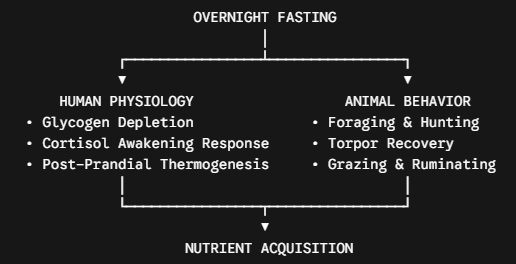
Human Physiology
During sleep, the human body maintains it's
metabolic homeostasis
via our
hepatic glycogen
reserves
Upon awakening
> Glucose Dynamics: Hepatic glycogen levels drop, signaling a need for carbohydrate
or gluconeogenic substrate replenishment
> Hormonal Regulation: Cortisol levels peak
( the Cortisol Awakening Response ),
elevating blood
pressure & preparing the body for active movement
> Insulin sensitivity is typically higher in the morning, optimizing nutrient absorption
> Satiety Signaling: Ghrelin
( the hunger hormone )
rises, driving appetite, while leptin drops
Non-Human Animals
While non-human species do not engage in cultural mealtime rituals, many exhibit distinct post-dormancy or post-awakening feeding behaviors:
> Diurnal Mammals & Birds:
Foraging & hunting each peak shortly after sunrise
Songbirds display high energetic expenditure at dawn
( the dawn chorus )
before seeking insect
or seed intake to restore lipids lost overnight
> Large Ruminants
( e.g., Cattle, Deer, etc )
Graze intensely in the early morning hours to fill the rumen, following an overnight period of reduced
gut motility
> Hibernators & Torpor Users:
Animals emerging from their daily torpor
( e.g., hummingbirds, bats )
experience rapid metabolic
elevation & seek immediate high-energy intake
( nectar, insects )
to offset steep body-temperature
restoration costs
3rd describes the Ancient Historical Practices
Antiquity to Medieval

Ancient Egypt
Egyptian agricultural laborers & elite alike ate an early morning meal.
Workers constructing monuments ate stews made of "fava beans"
( the ancestor of "ful medames" ),
"emmer wheat" bread, onions, garlic,
& low-alcohol barley beer for hydration & caloric sustenance
Ancient Greece
The classical Greek morning meal was known as "Akratismos"
( "ἀκρατισμός" )
Composition: Barley bread ( maza ) dipped in unmixed, diluted wine
( "akratos" )
with variations accompanied
by figs, olives, or pancake-like cakes such as
"staititēs" ( "σταιτίτης "), topped with honey & sesame
Ancient Rome
Romans called their early meal "Ientaculum" which consisted of flatbreads sprinkled with salt or soaked in wine,
paired with cheese, olives, or dried fruit
Soldiers were fed "Pulmentus," a dense porridge made from roasted spelt or barley cooked in cauldrons
Note: wealthier Romans often viewed early eating with suspicion, favoring a single massive meal
( "cena" )
late in the day
Medieval Europe
In Catholic Medieval Europe, breakfast had moral & religious overtones:
Gluttony Risk:
Eating early was often judged as a sin of passion
( "praepostere"—eating too early )
Class Split:
Monarchs & clergy typically ate two formal meals per day
( midday & evening )
Manual laborers, children, the elderly & the sick were permitted morning sustenance
( bread, ale & cheese )
out of physiological necessity
4th shares Historical Shifts:
Caffeinated Beverages & Industrialization
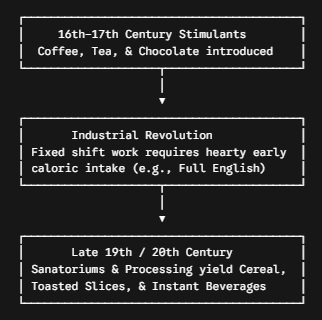
The global characteristics of breakfast changed dramatically due to these three historical developments:
1) The Introduction of Coffee, Tea, & Chocolate
( 16th–17th century )
was with the arrival of caffeinated beverages across Europe & the Americas that shifted morning drinking habits away from low-alcohol ale or mead toward hot stimulants
2) The Industrial Revolution
( 18th–19th century )
had agrarian routines gave way to factory schedules,
where workers needed substantial calories before long shifts.
This gave rise to heavy morning meals like the Full English Breakfast
( eggs, bacon, sausage, fried bread )
& North America's Lumberjack Breakfast
3) The Rise of Ready-to-Eat Cereal
( late 19th century )
in the United States, health reformers like Dr. John Harvey Kellogg developed cold grain cereals
( flakes, granola )
as digestible alternative breakfast foods
5th & finally, the Global Survey of Modern Breakfast Traditions
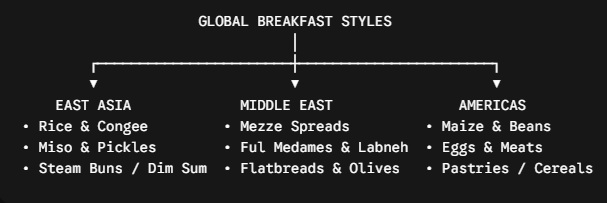
| Region | Primary Staples & Signature Dishes | Key Characteristics |
| East Asia ( China, Japan, Korea ) | Congee ( rice porridge ),
Miso soup, steamed buns ( "baozi" ), pickled vegetables, grilled fish & dim sum |
Savory, fermented, & warm; often mirrors dinner ingredients |
| South & Southeast Asia ( India, Malaysia, Vietnam ) | "Dosas idli parathas,"
"Nasi Lemak" & Pho soup |
High spice profile, steamed rice/lentil cakes & aromatic broth bases |
| Middle East & North Africa | "Ful medames,"
"labneh," falafel, "za'atar" flatbreads, "shakshuka," fresh herbs & olives |
Communal mezze-style plates, heavy reliance on legumes & olive oil |
| Europe | Continental: Croissants,
rolls, butter, jam, cheeses & cold meats Full British / Irish: Pork sausages, bacon, eggs, beans & fried tomatoes |
Split between light carb-centric offerings & heavily cooked meats |
| Americas | Latin America: "Gallo pinto,"
"chilaquiles," tamales & plantains North America: Pancakes, waffles, eggs, hash browns & processed cereals |
Heavy emphasis on corn, beans, maple syrups, or cured meats |
Moving on from my Global Perspectives on Breakfasts etc
( above ),
I've eaten many differing kinds of foods & have consumed many, many drinks
( both of which are expanded below )
in quite a few(!) countries
( each with many, many
places )
where I've lived or visited
with many of my friends, work associates & family since the 1950's…
Here's my list of each actual place
( shared in a calendrical-ish order )
that starts out in England and goes on to our most recent vacation in the northern state of
Alaska,
US of A
> My 1st meals & drinks were in the 50's from my Mum in
England
( my 1st place ),
where I started out as a baby,
with many thousands more of them held there
( shared at the start )
> We had a holiday in the early 60's at the Butlins holiday camp in
Wales ( 2 )
> There was a school trip to
Belgium
( 3, also shared
here )
in the late 60's
> After my 2+ years at the
AAC
in
Harrogate,
I was sent to
Germany ( 4 )
by the British Army in 1973,
where I served for a few years,
learning about those delightful Brätwurst sausages & enjoying many,
many gallons of beer(!)
> In 1974 I served in
Northern Ireland ( 5 )
for a 4-month tour of duty in Belfast during the IRA
troubles
> In 1979 Burroughs sent me to the
US of A ( 6 )
on a training trip, which is where I ended up living…
> During my many years with GE, I traveled on work-based trips in various roles to
France ( 7 ),
China ( 8 ),
Japan ( 9 ),
Mexico ( 10 ),
Israel ( 11 )
& with
Sandy
to
Czechoslovakia ( 12 ),
Hungary ( 13 ),
Poland ( 14 ),
Switzerland ( 15 ),
Taiwan ( 16 ) &
Hong Kong ( 17 )
> My many vacation places
( which are *not* in calendrical order! )
include
Spain ( 18 ) where we ( Sandy & I )
enjoyed visiting the
Basilica of the Immaculate Conception of Our Lady
in Barcelona
There are several other trips ( like Spain ) that are shared in my
eDiaries
but are not shared here…
Sandy booked a week in early 1999 for us at our 1st
Mexican
resort in
Puerto Vallarta
where we relaxed
on the beach,
helping with my recovery from the May'98
brain tumor
assault—another link is
here…
We then spent a week in 2001 at the
El Dorado Royale
resort in
Playa del Carmen
on the beach with my
brother Alan & AK,
as well as meeting up with Regina & Rigo
( who were staying at the Turquoise resort
in the Calle Kukulcán Villas, Cancún ) for a day!
We've since established our
Pueblo Bonito
resorts in
Mazatlán
& in
Cabo St. Lucas
with many more visits!
Next are my UK visits,
where I've had many trips after emigrating in '79 to the US of A—the 1st was in 1985,
when I took my family there for a
month,
my post-brain tumor
trip
in 1998
with
another
in 2000…
On one of my trips I visited
Land's End
but never made it to the
other end
of the UK!
Our awesome (!) trip to
Italy ( 19 )
was in May of 2019 for 3 weeks;
we had our 2-week river cruise in the
autumn of 2025 in
Portugal ( 20 )…
a little irritating but otherwise quite nice!
On our 2-week trip in June, 2006 we visited the UK, spending a week in
Ireland ( 20 )
& in the summer of
2017 we
visited
Germany, Austria ( 21 ) & France with a day trip to the
Neuschwanstein Castle
in Austria
A 2-week vacation for Steve Kerr's 70th birthday
surprise(!) was at his family castle in
Scotland ( 22 )
We visited a
Jamaica
resort ( 23 ) for a week in early 2003
& I took my family on a weekend+ ship cruise to
the Bahamas ( 24 )
in 1994
I went with Sandy's family in November of 2004 on a 2-week memorial visit
for Sandy's brother
Les
to
Hawaii
( yes,
it's only an island but as it is far, far outside of the US of A, I have it as a non-enumerated place )
which was ,
who loved it & had sadly passed away the year before
from cancer—far, far too young…
My many fishing trips took me up to the
Holinshead Lake
resort in
Canada
( my last place, the 25th )
in July'98 with friends…
on one of those trips, my friend John had forgotten to fill his
gas
tank!
After sharing the details of my many places
( above ),
I'll move on to the daily diet of humans, which today consists of many variations…
those meats,
fish,
insects(!),
birds & their eggs
( especially those from our
farm-based chickens )
& even snails,
etc,
which are each tracked down,
caught & then killed in the wild
( or on our farms, where some are grown to simplify things )
& are then prepared for us to eat at
our breakfast,
our lunch,
as a snack or
for our dinner,
either at home,
out at a delightful local restaurant,
traveling away from home for various reasons
( such as on one of our many
vacations
or during my
military years )
or just being out, enjoyably camping!
A side-note here is that I hunted for deer a few years ago up in northern Wisconsin with my
cross-bow
( which was needed vs. a regular bow due to the
disability
that caught me in the 1970's )
& my
rifle
( which I learned to use in the early 70's at the military
AAC
in Harrogate, Yorkshire )
with various friends, such as up at
Gerry's
cabin, catching and eating a couple !
The many, many vegetables that we eat today grow naturally in our home gardens or out in the wild &
are grown globally as crops by our
farmers
in their fields & in the huge rice paddies…
Those grown on farms are sold either at a stand,
in the
weekend farmers market
in town
or laid out in a
grocery store
for us to purchase
Here are some of the many, many choices…
cucumbers
( search for any of these as you choose by entering "describe the name" in
Google search? ),
sweet-corn cobs,
celery,
bell peppers,
broccoli,
cauliflower,
sugar snap peas,
snow peas,
Brussels sprouts,
tomatoes,
avocados,
zucchini,
scallions etc…
There are also the "root vegetables" that grow in the ground:
carrots,
onions,
various types of potatoes,
yams,
taro,
garlic,
radishes,
beets,
parsnips etc
and finally,
rice
which is grown in the rice paddies, feeding ~½ of our global population
Some of these are turned into "enhancements" by factories that process & can them up in various ways
( such as
sweet-corn,
peas,
carrots,
various beans such as
the green beans,
Lima beans &
baked beans, etc )
for us to purchase & consume.
Various fluids such as
water
( a key part of our diet! ),
wine,
soda,
beer &
alcoholic beverages
are each also consumed as we eat
As a passing thought on food, should we humans be unable to access our edible food for any reason,
we simply
die
( yes, in **agonizing** ways! )
in just a few weeks,
far, far less without liquids…
Each & every living thing on today's
planet
consumes their edible food at varying rates
( daily for us humans )
for simple sustenance
For many of our species on the land, each newborn creature begins to feed from their
mothers' milk,
progressing from birth to being fully grown.
Our human babies differ by having their daily food changed
( aged at just a couple of months )
to
baby food
( or similar foods )
that are purchasable around the Earth or that is grown;
in the times before being able to shop, this would have been food that was pre-chewed by their mothers!
A child becomes capable of chewing their food & swallowing it as they reach the early age of being a toddler;
youngsters,
pre-teens &
teenagers
each have different tastes before maturing to fully adult food…
this lasts until a person gets too old to eat stuff—back to that pre-chewed food, possibly
Creatures
that live on the
land
are ~86% of all the living things on Earth
( calculated as ~550 gigatons of carbon-based distribution )…
they hold a total planetary
biomass
that is heavily dominated by the trees & plants with the animals, fungi & the soil microbes
Those living in the deep subsurface's of the Earth are ~13% of the total planetary biomass,
composed almost entirely of microscopic life—vast populations of bacteria & archaic creatures that actually live thousands of meters below the surface,
both under the land & beneath the ocean floor
The creatures that live In the waters have literally just ~1% of the overall planetary biomass…
Despite covering over 70% of the Earth's surface,
the oceans account for only a tiny fraction of our planetary biomass yet host ~78% of all animal biomass, mostly the fish & crustaceans
Each of the creature groups listed above do have specific global diets:
the Carnivores
( that eat other living creatures )
are the most species-rich group with ~63% of all diets globally,
the Herbivores that eat grasses, flowers & fruits, etc
account for about 35% of all diets,
and the Omnivores
( a rare minority )
that can eat anything are at just 2%, which we humans have always been!
It is a common misconception that the herbivores outnumber the carnivores…
while there are physically more individual herbivores walking the earth
( with a higher biomass ),
there are far fewer species of them:
• The Insect Effects… Over half of all known animals on Earth are insects where the vast majority of insects,
spiders, and creepy-crawlies eat other insects or tiny organisms, which classifies them as carnivores
• The Plant Defense Barrier… Eating plants is incredibly difficult as it requires highly specialized
evolutionary adaptations—like multi-chambered stomachs, specialized teeth or complex gut bacteria—to
break down tough cellulose.
Because it is so hard to evolve these traits, fewer animal lineages successfully
transitioned into pure herbivores
• The Rarity of Omnivores… True omnivores are evolutionary generalists… while being an omnivore is highly
advantageous for survival, species tended to specialize over millions of years to become highly efficient
at processing either strictly meat or strictly plants, keeping the overall percentage of true omnivores very low
The birds
( both herbivores & carnivores )
each
fly,
walk
or
paddle
on the water
to eat many different things,
the
fish
that swim
( also both herbivores & carnivores ),
eating seaweed & other fishes,
and all those
reptilian
creatures that evolved from the
dinosaurs
( which were destroyed
by the
massively destructive impact of a 6-mile-wide asteroid 66 million years ago )
that live today on the land
or swim around in the waters consuming animals, bugs & plants
Even the bazillions of our buzzing
insects
& the many, many gazillions of
microbes
survive by eating some kinds of food that they prefer…
Our
plants
& trees evolved from the tiny
lichens
that grew on the
rocks
before any soils existed, between 450 & 600 million years ago,
surviving today all around the world & releasing the oxygen needed for everything else to live
whilst consuming the light from the
Sun
during the day & absorbing the
rain
( whenever it falls ),
the
seaweed
& other marine plants that all live below the surface in our global oceans
are **each eating** what they need, when they need in various ways…
The many, many
carnivorous
animals that reside all around the world are such as
a pride of lions
that hunt as a group of lionesses,
those sole hunters, the
tigers,
a pack of
wolves,
those frightening underwater killers—the
alligators
& those slithering, nasty
snakes
that eat no vegetation at all—they are carnivorous—and annoyingly, can be deadly to us!
They are each able to chase, catch & then eat everything that they choose to
This behavior is the same for the
omnivorous
land animals
( including us,
those enormous
grizzly bears,
the
raccoon's
&
many others )
There are also many incredibly aggressive birds, the
cormorants, pelicans & gannets
etc that each hurtle down from the sky to dive & catch fish for their food,
or those that use their claws to grab a fish to eat, the
eagles
as well as those that eat the small animals, the
hawks,
& the
owls…
the heavily-toothed fish, like the
sharks
& the
Orcas
that chase & eat seals & sharks in the ocean
**Each & every** creature listed in this group are eating another animal !
As a side-note, I actually got to see one of these events when we were
fishing
( scroll up to view? )
in Canada in the summer several years ago…
An eagle was watching me fish from a nearby tree & when I hooked a small
walleye,
killing it instantly as the hook went up into its head & as I discarded it, it flew down & grabbed it !
Today's
herbivores
are roughly 35% of all the animal species on Earth, equating to over 500,000 distinct herbivore species with the vast majority belonging to the insect world…
roughly ⅓ of the insects are plant-eaters,
including trillions of individual caterpillars, aphids & beetles.
While the meat-eaters
( carnivores )
actually make up the majority of the unique species in the animal kingdom,
the number of herbivores vastly outnumber them when counting the total number of individual living creatures & total biomass
The livestock that humans keep massively dominates the global herbivore population…
there are an estimated 3-4 billion domesticated herbivores living today—primarily cattle, sheep & goats—on the planet.
Today's wild herbivore populations are declining significantly, particularly the large megafauna…
only 8 terrestrial herbivore species weighing over 1,000kg remain today, the elephants, the rhinos & the hippos
While the
"Late Quaternary"
megafauna extinctions
( such as the
mammoths
& the
woolly rhinos )
had already concluded many millennia ago,
prior to around 1,000 years
ago
( in the Medieval period )
was when the global populations of wild herbivores were far larger & more expansive,
profoundly shaped by massive, free-roaming herds of large wild ungulates before rapid agricultural expansion,
widespread fencing & localized over-hunting drove many to the brink of extinction
We each prepare our meals at home [ more coming ]
I do intend to continue to expand my thoughts over the next few weeks !
To close my story about food, etc, allow me to add for you an expanded view of my many, many web pages via my
Profile
page…
also, do view my
"Whom We Might Be"
story?
I updated the
"Development of Don's Websites"
page in 2023 to share a more extensively detailed report
My
Ancestry
tree, which back in 2010 held a virtual duplicate of my then
static tree data…
That page shares the reports that I had extracted around 2016 from:
my
Stats & History
page, my
Key Generations
matrix & a list of my
Sources…
Today the report shares my current data in a restructured view of my
tree
data
Note: Ancestry does require you to sign in;
eMail
me if you need help?
Feel free to share your thoughts, comments or criticisms etc via
eMail?
Cheers!
Some relevant advisories:
(1) My family tree data is All Rights Reserved © April, 1988 – today's date Don Shave
(2) My Copyrighted (©) web pages do not hold any
Fake
data, nor are they using any
AI enhancements
3) As
legal issues
can surround such things as my published advice & opinions,
my
Privacy Policy & Disclaimers
page is a mandatory addition… please review?
Created in November, 2026
& last updated in
November, 2026
This website operates best under the Chrome browser;
other browsers & devices may fail to display correctly